


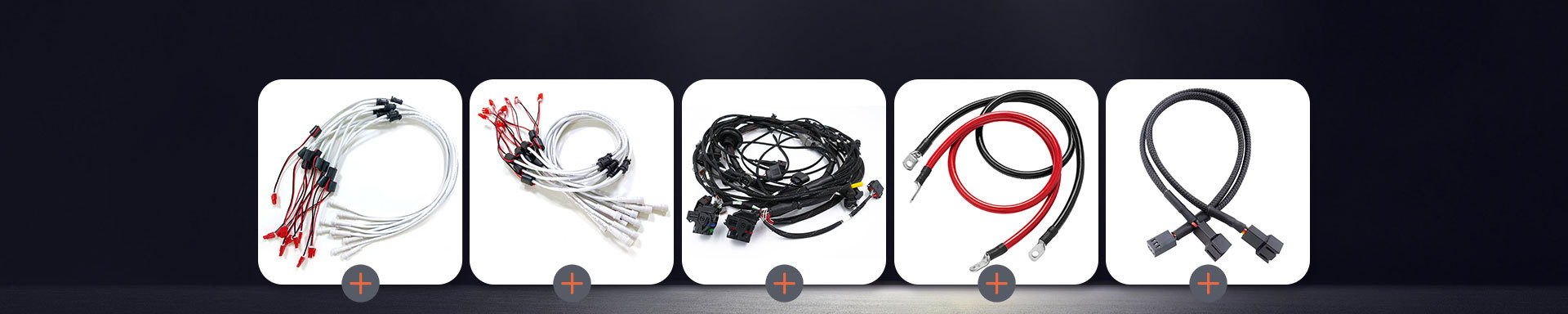
Why Pre-Crimped Custom Fork Terminal Single-Core Cable Assemblies Boost Industrial Panel Wiring Efficiency
2026-08-05 10:25Industrial control panels are becoming more complex, but wiring installation does not have to become slower. As automation equipment, PLC-based control systems, industrial computers, servo systems, and electrical cabinets continue to increase in complexity, manufacturers are looking for practical ways to reduce wiring labor while improving connection consistency.
One solution gaining attention is the pre-crimped fork terminal assembly.
Instead of sending loose wire to the assembly floor and requiring technicians to measure, cut, strip, crimp, and inspect every connection, manufacturers can purchase pre-processed cable assemblies manufactured to a defined specification.
For control cabinet manufacturers, automation equipment builders, and system integrators, this approach can turn repetitive manual wiring into a more standardized installation process.
Evershine provides customized wire and cable assembly solutions for industrial applications, including customized single-core copper wire, PVC insulated wiring for control panels, and industrial pre-made cable assemblies.
1. What Is a Pre-Crimped Fork Terminal Assembly?
A pre-crimped fork terminal assembly is a prepared electrical wire with a fork-type terminal securely crimped onto one or both ends.
Compared with loose wire, the assembly is delivered ready for installation.
A typical product consists of:
Copper conductor
PVC insulation
Customized wire length
Fork-type terminal
Controlled crimp connection
Optional wire identification or marking
The fork terminal is designed to connect with compatible screws, studs, terminal blocks, breakers, relays, controllers, or other electrical components.
For industrial applications, the key advantage is simple:
The wiring technician installs the finished wire instead of manufacturing the wire connection on site.
This makes the product particularly useful for repetitive wiring operations inside electrical cabinets and automation equipment.
2. Why Industrial Panel Wiring Is Becoming a Productivity Issue
Traditional control-panel wiring often involves several manual steps:
Measure → Cut → Strip → Select terminal → Crimp → Inspect → Install
When a cabinet contains hundreds or thousands of connection points, these repetitive operations can consume significant assembly time.
There are also several potential sources of variation:
Incorrect wire length
Inconsistent stripping
Wrong terminal selection
Incomplete crimping
Damaged insulation
Incorrect wire routing
Loose electrical connections
Human labeling errors
For a single prototype cabinet, these problems may be manageable.
For repeated production of the same control cabinet or automation machine, however, even small variations can become a measurable manufacturing cost.
This is why industrial pre-made cable assembly solutions are increasingly relevant to manufacturers looking to standardize their wiring process.
3. How Pre-Crimped Wiring Can Improve Assembly Efficiency
The main value of a pre-crimped assembly is not simply that it saves one crimping operation.
It shifts repetitive processing from the installation site to a controlled manufacturing environment.
Conventional wiring
Raw wire → cutting → stripping → terminal preparation → crimping → inspection → installation
Pre-made wiring
Finished cable assembly → inspection → installation
This can simplify the assembly workflow.
For high-volume equipment manufacturers, the benefits may include:
1. Reduced on-site processing
Technicians do not need to repeatedly strip and crimp individual wires.
2. More consistent connections
The crimping process can be standardized during production.
3. Easier production planning
The required wires can be supplied according to the equipment's wiring diagram or BOM.
4. Faster repetitive assembly
Workers can focus on routing and connecting instead of processing every wire.
5. Lower rework risk
Predefined dimensions and terminal specifications reduce the opportunity for individual operators to make different processing decisions.
4. Application Scenario: Control Cabinet Manufacturing
Control cabinets are one of the most suitable applications for pre-crimped single-core wires.
A typical cabinet may contain:
PLCs
Circuit breakers
Relays
Contactors
Terminal blocks
Power supplies
Sensors
Industrial communication components
Motor control components
Safety components
Many of these devices require point-to-point wiring.
With PVC insulated wiring for control panels, manufacturers can specify:
Wire gauge
Wire length
Wire color
Terminal type
Terminal size
Stripping length
Terminal orientation
Identification requirements
The finished assemblies can then be organized according to the cabinet's wiring plan.
This is particularly useful for OEM cabinet manufacturers producing multiple units with similar electrical configurations.
5. Application Scenario: Automation Equipment
Automation machinery frequently combines electrical control, sensors, motors, actuators, and safety systems.
The wiring requirements can therefore vary significantly between projects.
A customized assembly can be manufactured according to the machine design.
For example:
PLC terminal → custom single-core copper wire → fork terminal → relay
or:
Power distribution point → customized PVC wire → fork terminal → control component
Instead of having the equipment assembler manufacture each wire during final machine assembly, the cable assemblies can arrive ready for connection.
This is especially useful when the same machine model is manufactured repeatedly.
6. Application Scenario: System Integration Projects
System integrators often face another challenge: project schedules.
Electrical panels may need to be assembled quickly after mechanical installation and component procurement.
When pre-processed cable assemblies are available, the wiring team can reduce several preparation steps.
For integrators handling multiple projects, standardized cable assemblies can also make wiring documentation and material management easier.
The practical value is not necessarily that every installation becomes dramatically faster. Rather, the wiring process becomes more predictable and repeatable.
7. Product Technology: Why Copper and PVC Matter
A pre-crimped assembly is only as reliable as its basic materials and manufacturing process.
Copper Conductor
The conductor directly influences electrical conductivity and resistance.
For industrial wiring, buyers should confirm:
Copper material
Conductor structure
Cross-sectional area or AWG
Stranding
Resistance
Current-carrying requirements
A properly specified custom single-core copper wire provides predictable electrical performance for the intended application.
For engineering procurement, it is better to specify the conductor according to electrical requirements rather than simply selecting a wire based on external diameter.
8. PVC Insulation Provides Practical Protection
PVC is widely used in industrial wiring because it provides electrical insulation and practical mechanical protection.
For control-panel applications, the insulation specification should be matched to the actual working environment.
Key parameters may include:
Rated voltage
Temperature range
Insulation thickness
Flexibility
Flame-retardant requirements
Resistance to environmental exposure
For standard indoor control cabinets, conventional PVC insulation may be appropriate.
For applications involving elevated temperatures, oils, chemicals, outdoor exposure, or continuous flexing, the cable construction should be reviewed separately.
Therefore, the phrase PVC insulated wiring for control panel should always be accompanied by an actual technical specification.
9. The Fork Terminal Crimp Is the Connection's Critical Point
The terminal may be a small component, but the crimp connection plays a major role in electrical and mechanical reliability.
An appropriate crimp should provide:
Secure conductor retention
Stable electrical contact
Correct terminal positioning
Consistent deformation
Appropriate mechanical strength
A poor crimp can potentially lead to:
Increased contact resistance
Intermittent connection
Terminal pull-out
Localized heating
Equipment malfunction
This is why a professional supplier should not treat crimping as a simple manual operation.
For mass production, the crimping process should be controlled using suitable tooling and inspection procedures.
10. Technical Parameters Buyers Should Confirm
Before purchasing a pre-crimped fork terminal assembly, procurement teams should establish a complete specification.
| Parameter | What to Confirm |
|---|---|
| Conductor | Copper type and construction |
| Wire size | AWG or mm² |
| Wire length | Finished length and tolerance |
| Insulation | PVC type and rating |
| Wire color | Required color |
| Terminal | Fork terminal model |
| Fork opening | Match screw/stud size |
| Terminal material | Required material |
| Plating | Tin-plated or specified finish |
| Strip length | Drawing-defined |
| Crimp | Approved crimping process |
| Marking | Labels, numbers, or printing |
| Compliance | RoHS / REACH where required |
| Packaging | Quantity and identification |
A detailed drawing is particularly useful for custom projects because it eliminates ambiguity between the customer's engineering team and the supplier's production team.
11. Procurement Pain Point: "Can the Supplier Maintain the Same Quality in Mass Production?"
This is one of the most important questions for B2B buyers.
A sample can look perfect.
But the real test is whether the supplier can reproduce the same result across thousands of pieces.
A qualified supplier should have controls covering:
Incoming material inspection
Checking wire, terminals, and other incoming components.
First-piece inspection
Confirming the first production assembly against the approved specification.
In-process inspection
Monitoring wire length, stripping, crimping, and assembly parameters.
Electrical inspection
Checking continuity and other agreed electrical requirements.
Mechanical inspection
Verifying terminal retention or pull-force performance where required.
Final inspection
Checking appearance, dimensions, terminal condition, markings, and packaging.
The objective is batch consistency, not merely sample quality.
12. Procurement Pain Point: "Will the Terminal Actually Match My Equipment?"
Never purchase a fork terminal based only on the description "fork terminal."
The supplier should confirm:
Screw/stud diameter
Fork opening
Terminal thickness
Wire size range
Terminal material
Plating
Installation environment
A mismatch can result in poor mechanical fit or installation difficulties.
For custom projects, customers should ideally provide the terminal part number, drawing, sample, or mating-component dimensions.
13. Procurement Pain Point: "Can I Order a Small Batch Before Mass Production?"
For new equipment projects, purchasing a large volume immediately can create unnecessary risk.
A more practical workflow is:
Prototype → Sample → Engineering validation → Pilot order → Mass production
This allows the customer to verify:
Wire length
Terminal compatibility
Installation convenience
Crimp quality
Electrical performance
Packaging
Assembly process
For this reason, suppliers that support both small-batch trial orders and large-volume production can provide greater flexibility for OEM customers.
14. How Evershine Supports Custom Industrial Cable Assembly
Evershine focuses on the development, manufacturing, and supply of wires, cables, and wiring harness products for industrial and OEM applications.
For customized fork terminal cable projects, Evershine can support customers with specifications such as:
Custom wire length
Custom wire gauge
Custom PVC insulation specifications
Fork terminal selection
Terminal configuration
Stripping length
Crimping requirements
Wire color
Identification requirements
Batch production
Quality inspection
The production approach is suitable for customers moving from engineering samples to repeated production.
Evershine's typical customization process
Customer drawing / sample
↓
Technical specification confirmation
↓
Material and terminal evaluation
↓
Sample production
↓
Customer approval
↓
Small-batch trial order
↓
Mass production
↓
Final inspection and shipment
This workflow gives control cabinet manufacturers and automation equipment builders a clearer path from prototype development to stable supply.
15. Why Factory-Direct Supply Matters for OEM Buyers
When purchasing customized cable assemblies, the supplier's production capability matters as much as the product itself.
Factory-direct sourcing can provide several practical advantages:
Faster communication with engineering teams
Direct technical specification confirmation
Easier sample modification
Better control of production requirements
More direct quality feedback
Flexible production quantities
Better coordination for recurring orders
For custom products, these advantages can be more important than simply finding the lowest quotation.
A reliable supplier should be able to answer a technical question with a production solution rather than simply providing a price.
16. Data Evidence: How to Measure Wiring Efficiency Improvements
Instead of asking whether pre-crimped wiring is "faster," manufacturers can measure the actual production effect.
Track these indicators before and after implementation:
| KPI | Traditional Wiring | Pre-Crimped Assembly |
|---|---|---|
| Wire preparation steps | Multiple manual steps | Reduced |
| On-site stripping | Required | Eliminated |
| On-site crimping | Required | Eliminated |
| Connection consistency | Operator-dependent | Process-controlled |
| Rework sources | Multiple | Reduced |
| Material identification | Manual | Can be pre-organized |
| Assembly standardization | Variable | Higher |
For an OEM factory, the most useful measurement is not a generic percentage claim.
Instead, calculate:
Labor hours saved per cabinet × cabinets produced per month
Then compare this with the procurement cost of the pre-made assemblies.
This provides a more realistic basis for deciding whether the solution delivers measurable ROI.
17. When Should You Choose a Pre-Crimped Cable Assembly?
A pre-crimped solution is particularly attractive when:
You manufacture the same equipment repeatedly
Standardized assemblies can be reused across production batches.
Your cabinets contain many repetitive connections
The more repetitive the wiring operation, the more valuable process standardization becomes.
Your wiring team is under production pressure
Pre-processed wires reduce manual preparation work.
You want to reduce operator-dependent variation
The supplier performs the crimping under controlled production conditions.
You are scaling from prototype to mass production
The same approved cable specification can be transitioned into repeat orders.
18. 2026 Industrial Wiring Trend: From Components to Pre-Engineered Assemblies
Industrial automation is moving toward greater modularization and manufacturing standardization.
The change is not only happening at the equipment level.
It is also occurring at the component level.
Instead of purchasing:
Wire + terminal + tools + labor
manufacturers can increasingly purchase:
Finished cable assembly
This reflects a broader manufacturing principle:
Move repetitive manual processing away from the final assembly line whenever it can be standardized and quality-controlled upstream.
For control cabinet manufacturers, automation equipment builders, and system integrators, this can make wiring more predictable while reducing unnecessary assembly operations.
19. A Practical RFQ Checklist for Buyers
When requesting a quotation for a custom single-core copper wire assembly, provide:
Wire gauge / AWG
Finished wire length
Conductor specification
PVC insulation specification
Wire color
Fork terminal model
Fork opening size
Terminal material and plating
Strip length
Terminal orientation
Required quantity
Drawing or sample
Application environment
RoHS / REACH requirements
Sample quantity
Required delivery date
Packaging requirements
Providing this information at the beginning can significantly reduce quotation clarification and sample revision cycles.
20. From Manual Wiring to a More Efficient Assembly Process
For industrial panel manufacturers, the question is no longer simply:
"How much does one wire cost?"
A more useful question is:
"How much does it cost to prepare, install, inspect, and potentially rework one wire connection?"
A pre-crimped fork terminal assembly addresses this broader cost equation by supplying a ready-to-install connection.
With correctly specified copper conductors, suitable PVC insulation, compatible fork terminals, controlled crimping, and batch-level inspection, the solution can support a more standardized industrial wiring process.
For manufacturers looking for industrial pre-made cable assembly solutions, Evershine can support customized production from small trial orders through larger-volume manufacturing.
If you are building control panels, automation equipment, electrical cabinets, or industrial systems, send Evershine your drawing, sample, BOM, or cable specification.
The engineering team can evaluate the required wire gauge, length, PVC insulation, fork terminal, crimping configuration, and production quantity, then develop a cable assembly matched to your installation requirements.
Evershine — Custom Wire, Cable and Wiring Harness Solutions for Industrial OEM Applications.